
What does guided surgery planning actually cost?
Guided surgery planning generally runs anywhere from about $15 to well over $100 per implant site, depending on the provider, the complexity of the case, and whether surgical guide fabrication is bundled in or billed separately. At Denta Dynamics the rate is a flat $15 per tooth being planned, with guide design available on request, but that wide industry range is not random. It comes down to a specific set of factors worth understanding before you compare quotes side by side.
What actually goes into a planning case
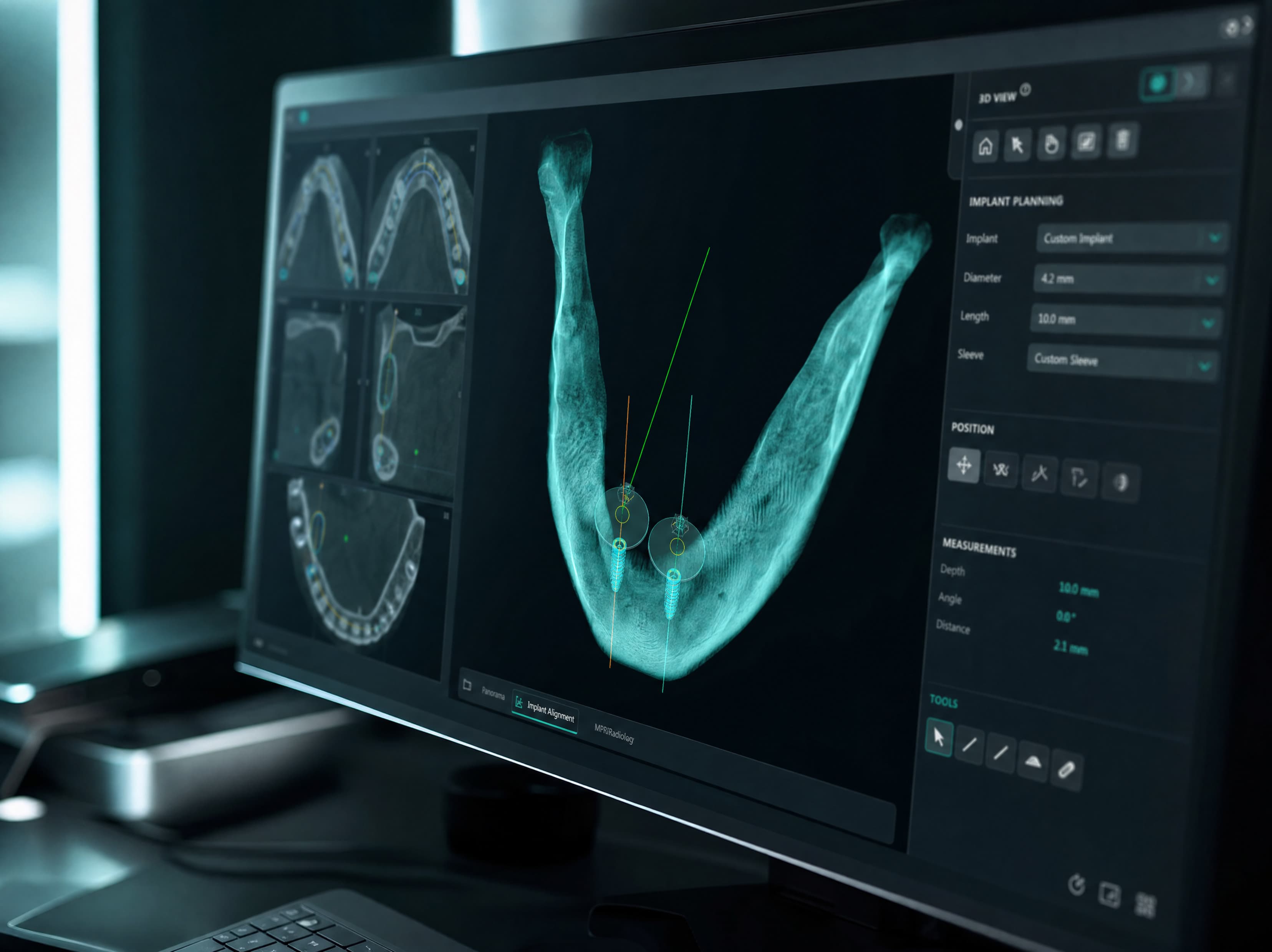
A planning fee is not just paying someone to click a button in software. A proper case involves reviewing the CBCT scan for usable quality, merging it with an intraoral or model scan so the plan accounts for both bone and tooth position, placing the implant virtually against the real anatomy, checking that position against where the final restoration needs to sit, and writing up a report you can actually act on in surgery. If a guide is included, that is a separate design and manufacturing step on top of the planning itself. Providers charging very little are sometimes skipping one of these steps, most often the prosthetic check or a written rationale, rather than doing the same work faster.
What makes the price go up
A few things reliably move the cost:
Case complexity. A single implant in a straightforward site costs less to plan than a full-arch case with multiple implants, limited bone, or proximity to the nerve canal or sinus that needs closer attention.
Whether the guide is included. Planning alone (a report telling you where and how deep to place the implant) is cheaper than planning plus a designed and manufactured surgical guide, since the guide adds its own design time, material, and production step.
Revisions. A provider that includes a reasonable number of revision rounds in the base price is different from one that charges for every change after the first draft. This matters more than it sounds, since a first plan is not always the final plan once you review it against your own clinical judgment.
Turnaround speed. Rush turnaround, same-day rather than a standard multi-day window, often carries a premium, which is fair given the compressed work, but it should be a clearly stated option rather than the only speed available.
In-house versus outsourced. A clinic or lab planning cases in-house is paying for software licensing and a trained planner's time regardless of case volume that month. An outsourced, per-case price scales with how many cases you actually send, which is part of why per-tooth or per-case pricing tends to look cheaper on paper for lower and moderate volumes.
What you should actually receive for that price
Whatever a provider charges, a complete planning deliverable should include a clear statement of implant position, angulation, and depth for each site, a written rationale you can review before anything is manufactured, the option to request a surgical guide design if you want one, and a defined number of revision rounds if the plan needs adjusting. If a quote does not specify what you get for it beyond "a plan," that is worth asking about directly before you send a case.
How to compare providers beyond the sticker price
Price alone is a poor way to compare planning providers, since a low price with no revision policy and a vague turnaround can end up costing more in back-and-forth than a slightly higher price from someone who gets it right the first time. Worth checking directly: whether turnaround is stated as a specific number rather than "it depends," how many revision rounds are included, whether the report explains the reasoning behind the placement or just gives you coordinates, and who is actually reviewing the case. A plan reviewed by someone with real clinical experience, not just software proficiency, is more likely to account for the restorative side of the decision rather than just where there happens to be bone.
Where the real cost differences come from
The honest reason prices vary this much across the industry is that "guided surgery planning" is not one standardized product. A $15 per-tooth rate and a $150 per-arch rate can both be fair prices for genuinely different scopes of work, one focused purely on implant position, the other bundling guide fabrication, multiple revision rounds, and a same-day turnaround. The way to actually compare two quotes fairly is to ask both providers the same specific question: what exactly is included, and what would it cost to add whatever is missing.
What this costs with Denta Dynamics
To be direct about our own pricing rather than leaving it vague: Denta Dynamics prices implant planning at a flat $15 per tooth being planned, whether it is a single implant or a full-arch case, with surgical guide design available on request and a set number of revision rounds included. The plan is reviewed by a practicing dentist before it comes back to you, and turnaround is 24 hours from case submission. If the final restoration also needs to be designed, our Exocad design service covers that at the same per-tooth rate.